
Steve Schuckman’s Impact on Cincinnati
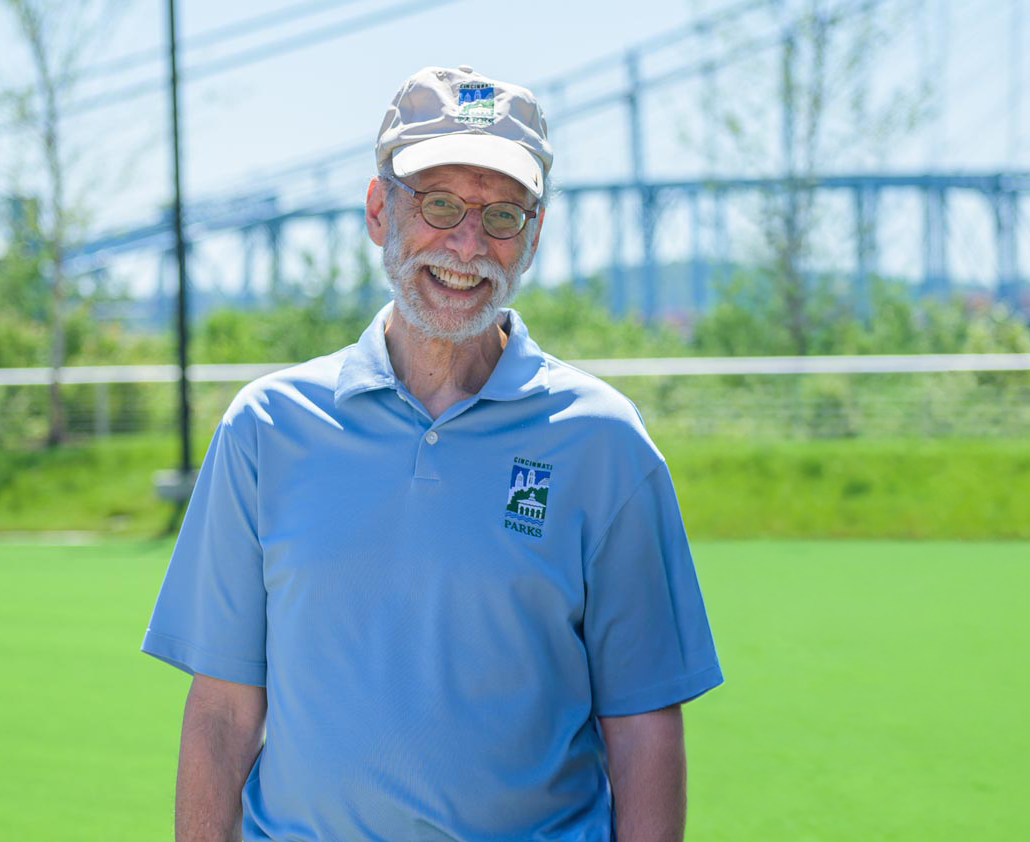
Steve in 2021 at Smale Riverfront Park
Cincinnati tells its story through its public spaces. Its hills, overlooks, wooded trails, riverfront promenades, and neighborhood parks are not just amenities; they are part of the city’s identity. Few people did more to shape that identity in recent decades than Steve Schuckman. Over a 42-year career in Cincinnati city government, including 32 years in the Parks Department, he helped guide the vision, design, and long-term direction of some of the city’s most important public landscapes.
Touching Every Corner of Cincinnati
Steve Schuckman was a planner, designer, preservationist, and longtime public servant whose work touched nearly every corner of Cincinnati’s park system. He began his career as a city planner in Springfield, Massachusetts, then moved to Cincinnati, where he spent 10 years working with the city’s Historic District Commission before joining the Parks Department. He later served as Superintendent of Parks, Acting Director of Parks, and manager of the Planning and Design Division. Trained in architecture, he brought together design thinking, civic planning, and historical stewardship in a way that made him unusually influential inside city government.
His career sat at the intersection of preservation and reinvention. Early on, he worked on historic districts, neighborhood planning, and preservation guidelines. In parks, he became one of the people most responsible for carrying Cincinnati’s historic park tradition into the modern era. He was closely tied to the city’s 1992 parks and greenways plan and the 2007 Centennial Master Plan, two documents that helped define how Cincinnati would think about parks not as isolated properties, but as a connected civic system.
Impact on Cincinnati Parks
Schuckman’s biggest contribution was helping Cincinnati think bigger about what parks could do. The 2007 master plan framed parks as essential to quality of life, economic development, neighborhood investment, environmental health, and public safety. It also emphasized a park system that is well distributed, accessible, and connected through greenspace. That way of thinking helped move Cincinnati beyond treating parks as scattered amenities and toward treating them as core civic infrastructure.
That vision can be seen most clearly along the riverfront. The same planning framework pushed Cincinnati toward a stronger connection between downtown and the Ohio River and treated riverfront park development as central to the future of the entire park system. Schuckman was later recognized by Cincinnati Parks leadership as instrumental in the city’s major riverfront park work, as well as in projects such as Washington Park, Ziegler Park, Westwood Town Hall, and Kyle Plush Pavilion. His influence was not limited to one signature site; it stretched across the city’s most visible park transformations over several decades.
His impact also showed up in the way projects were built. He helped bridge public agencies, neighborhood priorities, and private philanthropy to turn ideas into durable public spaces. At Eden Park’s Tom Jones Commons, for example, he helped shape a plan that transformed an underused reservoir area into a new gathering place with wetlands, trees, paths, and stronger connections to surrounding institutions and neighborhoods. That kind of work reflected a broader pattern in his career: using design not just to beautify parks, but to make them more connected, welcoming, and useful.
Just as important, Schuckman’s work balanced ambition with stewardship. He championed public art, new trails, and additional green space while also advancing historic preservation within the park system. He was instrumental in placing Mt. Airy Forest on the National Register of Historic Places, reinforcing the idea that Cincinnati’s parks are not only places for recreation, but also part of the city’s cultural and environmental inheritance.
A Civic Legacy
Schuckman’s legacy will live on for quite a long time in Cincinnati Parks. The landscapes he helped shape influence how Cincinnatians gather, move through the city, and experience neighborhood life. When his retirement was announced in 2021, Cincinnati Parks leadership said he had been instrumental in every major park project over the previous three decades and described the department’s future as continuing the vision he helped build. That is a rare kind of civic legacy: not just a list of completed projects, but an enduring way of thinking about public space.
Even after retirement, he remained engaged with Cincinnati’s landscape history, understanding it as something to be protected, interpreted, and handed forward. That sensibility may be the clearest measure of his influence. Steve Schuckman did not simply help improve parks; he helped deepen Cincinnati’s understanding of why they matter.
Announcing the Steve Schuckman Tai Chi Series
Free monthly Tai Chi and mindfulness classes at Owl’s Nest Park offer a meaningful way to experience the kind of public space Steve Schuckman helped champion throughout his career. Presented through Cincinnati Parks + Rec for Wellness in partnership with the Osher Center for Integrative Health at the University of Cincinnati, and typically held on the third Wednesday of the month at noon, the classes welcome neighbors to gather in a setting shaped by calm, connection, and care. Led by certified instructor Jennifer Woods, the series reflects Schuckman’s lasting impact on Cincinnati Parks: creating places that are not only beautiful and historic, but alive with everyday community use.